
Carbon Monoxide (CO) is commonly known as the silent killer. It didn’t gain that name because it tiptoes in through the back door. However, it can enter your home without you ever knowing.
Instead, it’s because the toxic gas is colourless, odourless and tasteless.
It’s estimated to cause around 40 deaths per year in the UK, but because of the difficulty in detecting it, experts suggest the actual figure is much greater.
That means you could be suffering from the effects of carbon monoxide inhalation, and be completely unaware. But you can avoid that being the case by investing in a carbon monoxide alarm.
Installing these in your home will help you to protect yourself and your family from suffering the effects of CO poisoning.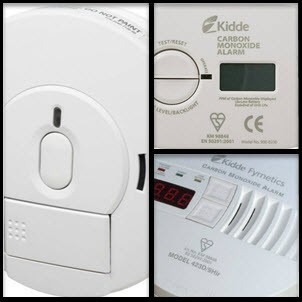
We’ve put together a guide which will help you understand what can cause carbon monoxide and how to prevent it, and also how important it is to have alarms in your home to keep you safe.
What Is Carbon Monoxide?
CO gas is always produced from the burning of fossil and carbon fuels. This includes gas, oil, coal and wood.
These are usually safe to burn without causing any harm. But when the fuel doesn’t burn properly, it can produce carbon monoxide. One physical sign of this can be the flame burning yellow instead of blue on gas appliances.
When an appliance begins to burn the fuel ineffectively, it is often an indication that there is a problem which needs resolving immediately.
That is because the carbon monoxide produced is highly poisonous to our bodies.
What Are The Symptoms Of CO Poisoning?
Because you can’t see, taste, smell, or even hear CO, it’s easy for us to inhale it unawares. But people exposed to it often experience symptoms which go misdiagnosed as the flu. These may include headaches, dizziness, drowsiness, breathlessness, nausea and eventual loss of consciousness.
Children, the elderly, or people with existing medical conditions are much more sensitive to the effects. 56% of people admitted to hospital for the effects of CO poisoning are either under 14 or over 65 years old.
And exposure to high levels can, unfortunately, lead to brain damage and death.
It has this effect because once it has entered your body, it gets into your blood stream. It then prevents your body from being able to transport oxygen properly. Even though it doesn’t physically choke you, it has the same effect.
One way of becoming aware of the poisoning is if symptoms subside when away from the home. Often breathing clean air is enough to make the symptoms better.
But of course, the more fool-proof way of detecting carbon monoxide is to have a CO alarm fitted in your home.
How Can I Prevent Carbon Monoxide In My Home?
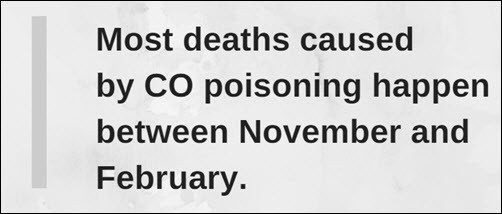
Most deaths caused by CO poisoning happen between November and February.
This comes as no surprise because this is the time when most people seek ways of keeping their homes warm.
Often, carbon monoxide comes from faulty fossil fuel- and wood-burning appliances.
Getting a registered professional to check your appliances regularly is the best method of prevention you can use. That means having an engineer on the gas safety record checking your boiler once a year, and if you have a chimney, having it swept and inspected at least once a year by a professional chimney sweep.
In either case, they will service and check the condition of your appliances, and give advice on any work they recommend undertaking. When you have new appliances installed, hire a professional to undertake this work.
This is because badly fitted and poorly maintained appliances are the biggest source of CO.
Having a CO alarm installed should not replace regular servicing.
And likewise, having your appliances annually serviced is not a replacement for having a carbon monoxide alarm in your home. Taking these actions gives you the best chance of preventing CO poisoning in your home.
But, like with anything, you cannot completely remove all risks. This is because carbon monoxide can seep through walls from a neighbouring property.
And if you have a garage attached to your house, a car left in there running can also be a source of carbon monoxide.
So even if you relieve your home of all hazards, there will always be a risk, however small. Therefore, all homes should install a CO alarm.
What Are Carbon Monoxide Alarms?
A common misconception is that a CO alarm is not needed if people have smoke alarms in their home.
A normal smoke alarm will never detect the presence of carbon monoxide. Smoke is very different from gas.
So for the best level of protection, you should have a mixture of both smoke and CO alarms in your home.
Carbon Monoxide alarms contain a chemical solution which has electrodes immersed in it. When this chemical comes into contact with the gas, it then causes a chemical reaction. This small change is then detected by the sensors, which is what triggers the alarm.
Once the alarm has started sounding, it will only stop once the chemical reaction is no longer occurring. In other words, once the area around the alarm is carbon monoxide-free.
Statistics
What Types Of Carbon Monoxide Alarm Are Available?
There are a variety of different types of CO alarm, which means you will have no problem finding one to suit your needs.
Battery- and mains-powered carbon monoxide alarms are the most popular. However, you can also buy alarms which plug into a power outlet. The latter means you can easily move them between rooms, and can quite easily take one on holiday with you.
Although very convenient with no installation fuss, they will not work in the event of a power cut.
Instead, battery- and mains-powered CO alarms are a better option to have in your home.
Firstly, this is because they are a permanent fixture which gives you better protection all the time, and in the event of a power cut, they will both still operate. With battery CO alarms, you can choose one which comes with a 7- or 10-year lithium battery.
That means you don’t have to worry about changing the batteries and they are harder to tamper with.
Or you can get ones which take standard AA batteries and will need replacing annually. These are often the cheaper option.
With mains-powered CO alarms, they are often fitted into the lighting circuit. These are also fitted with long-life lithium batteries, which will allow them to work even when the power is off.
You can also purchase a combined optical smoke and carbon monoxide alarm. This means that they have the components to detect both. And so you know which danger it’s detected, they can have a spoken alarm to tell you.
What Features Do CO Alarms Have?
Most CO alarms check the environment every 15 seconds to keep you protected.
You can purchase CO alarms which have the ability to interlink with other CO and smoke alarms. This would mean that all the alarms will sound when any of the alarms detect a threat. That, in turn, means everyone in the home is instantly warned, regardless of where they are. The alarms use either wireless technology or a wired connection to do this.
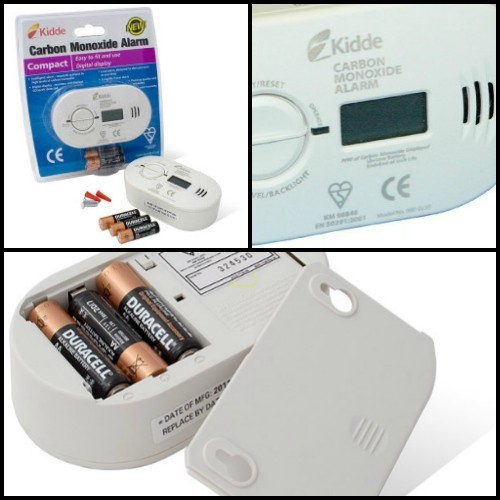
Some CO alarms also have a digital display.
This can display when there is a very low level of carbon monoxide to provide an early warning.
They can also keep a record of CO levels. This means when you return home from work or a holiday, you can track whether levels increased in your absence.
If you have a combined alarm, the display will also show whether the danger is smoke or CO.
How Many And Where To Install?
We are at our most vulnerable to suffering carbon monoxide poisoning when we sleep. So if you’re only going to have one alarm, then place it near your family’s bedrooms.
Ideally, you will have CO alarms throughout your home, just like you do with smoke alarms. You should have at least one on every floor of your home.
But for the best level of protection, it makes sense also to keep detectors in rooms which contain possible sources, so that could mean one in the kitchen where your gas boiler is, and one in the living room if you have a fireplace.
That will give your family an early warning, enabling you to quickly resolve the problem before any of you suffer any serious effects.
Once you’ve decided which rooms you want your CO alarms in, you’ll need to install them.
Don’t place carbon monoxide alarms on the ceiling with your smoke alarm (unless you have a combined unit). Unlike smoke, carbon monoxide doesn’t necessarily rise to the ceiling. Instead, it evenly distributes itself throughout the room, and then the home.
The best place to install them in the home is on walls. If you choose an alarm with a digital display, then place it where you can read the display.
When deciding at which height to install the alarm, it can depend on which room it is going in.
When in the same room as an appliance, it should go on the wall above the height of doors and windows. This is because the gas often comes out of the appliance heated and as we know, warm air rises.
Also, take care to place it between one and three metres away from any potential source.
If you are installing the alarm in a room as a precaution, such as in a bedroom, then it would preferably go lower. Mounting it on the wall at the same height as the bed means it will be monitoring the same air you’re breathing.
Should this not be possible because of tiny hands or paws potentially playing with the alarm, then they can go higher.
With the alarm fitted onto the walls, make sure to stop curtains and furniture from blocking it. To prevent false alarms, don’t place them next to vents or where steam from sinks or in the bathroom can affect them.
Avoid smoking near CO alarms as well, as that can be enough to trigger an alarm.

How Do I Maintain And Test Carbon Monoxide Alarms?
You should look after your CO alarms just like you do your smoke alarms.
Putting a vacuum cleaner over them every so often will remove any dust or cobwebs in the alarm. And you can give it a quick wipe with a damp cloth.
They also come with a test button, so make sure you test these alarms when you test your other alarms weekly. This will perform a check on the electronics inside and ensure the alarm still sounds. If it doesn’t sound, then chances are you need to replace the batteries.
Regardless of what type of alarm you have, it won’t last forever.
Their lifespan can vary, but the sensors tend to only last between 7 and 10 years (check instructions for lifespan information). After this time, the alarm can become ineffective at detecting carbon monoxide, so will need replacing.
Many of these alarms will alert you when they are reaching the end of their life.
What Should I Do If My CO Alarm Goes Off?
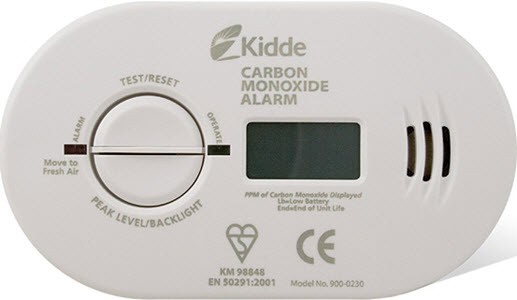
An intermittent alarm is a sign that there is a fault with the alarm. This could be because the batteries need changing or the alarm is at the end of its life.
Reading the instructions will allow you to understand what different sounds are warning.
Should the alarm continuously sound, then take action. It’s telling you that the alarm has detected dangerous levels of carbon monoxide in the environment.
If this is the case, then don’t panic.
Take this warning seriously. Just because you can’t see it like smoke, doesn’t mean the threat isn’t there.
Firstly, turn off all the appliances and the gas supply. Then ventilate your home by opening the doors and windows. Then get out of the house. Call a gas engineer and they will immediately come and investigate the cause. They will then advise on what action you need to take.
In the meantime, you should survey the health of everyone and check for symptoms which suggest CO poisoning. If any of them, including yourself, have potential symptoms, then seek medical advice.
You can do this by contacting your local health centre or by calling NHS Direct. They will also advise on the best cause of action to take.
If you were only briefly exposed to the symptoms, then chances are fresh air will be enough.
But exposure to CO over a long period of time can have a more serious impact on your health.
However, your carbon monoxide alarm will warn you long before that happens.
This highlights the importance of having carbon monoxide alarms in your home.
Having a system of smoke and CO alarms means that you know your family is always protected from any serious risks.